

“Running environmental protection equipment means losses, while shutting it down leads to fines” – this is the dilemma that many small and medium-sized manufacturing enterprises (SMEs) have faced. According to the “2024 Survey on the Environmental Protection Status of Small and Medium-Sized Manufacturing Enterprises,” over 60% of the surveyed enterprises believe that “environmental protection investments squeeze production funds.” However, data from the same period also shows that 35% of enterprises failing to meet environmental requirements have fallen into operational difficulties due to penalties or lost orders. With the advancement of global carbon neutrality goals, the shift from “campaign-style” to “normalized” environmental supervision, and the rigid requirements for “green product certification” from end markets (especially international buyers and major e-commerce platforms), issues such as fabric waste in sewing workshops (accounting for 15%-20% of total fabric on average), plastic waste pollution from injection molding (producing approximately 800 tons of waste plastic per 10,000 tons of injection-molded products), and solvent emissions from silicone processing (VOCs emission concentrations often exceeding international standards by 3-5 times) have evolved from “cost burdens” to “survival bottom lines.” Nevertheless, green process innovation is not a choice of “spending heavily on equipment,” but a necessary measure to achieve “compliance, cost reduction, quality improvement, and order acquisition” through process optimization, recycling, and material upgrading. It is also a key path for SMEs to build differentiated competitiveness in homogeneous competition.
I. Breaking the Cognitive Misunderstanding: Green Processes Are Not a “Cost Black Hole”
SMEs’ resistance to green transformation mostly stems from the cognitive bias of “high investment and low return,” and some even equate it with “purchasing expensive environmental protection equipment.” In fact, lightweight green transformation focusing on core processes generally has an investment return period of 1-2 years, and can bring triple benefits: “direct cost reduction + policy subsidies + order premium.” The following two sets of data, combined with specific enterprise scales, intuitively demonstrate its value:
Pain Points of Traditional Models
- Injection molding enterprise (50 tons/month output): Waste plastic generation is about 4 tons/month, with a disposal cost of $120/ton, resulting in an annual expenditure of $5,760; traditional motors consume 200 kWh/day, with annual electricity costs exceeding $9,000.
- Sewing enterprise (50 employees): Monthly fabric consumption is 10 tons, with a utilization rate of only 75%, leading to 30 tons of annual fabric waste. Calculated at an average price of $4.5/meter (approximately 1.5 tons/10,000 meters), the waste cost exceeds $9,000 per year.
- Silicone enterprise (10 tons/month output): Monthly consumption of solvent-based release agent is 500 liters, with frequent VOCs emission exceeding standards. A single fine can reach $30,000, and the annual environmental risk cost exceeds $7,500.
Benefits of Green Transformation
- Injection molding enterprise: Through waste plastic recycling and frequency conversion transformation, raw material costs are reduced by 12% ($4,320 saved annually), electricity costs are reduced by $2,700, and the annual net income exceeds $7,500 with subsidies.
- Sewing enterprise: With intelligent nesting and leftover material recycling, fabric costs are reduced by 18% ($1,944 saved annually), and annual income from waste material sales increases by $4,500, resulting in a total annual benefit of over $6,000.
- Silicone enterprise: By replacing with environmentally friendly solvents and installing waste gas collection systems, compliance costs are reduced by 60% ($4,500 saved annually), consumable costs are reduced by 30% ($4,050 saved annually), and it becomes eligible to undertake foreign trade orders.
II. Process-Specific Green Transformation Plans: Achieving Significant Breakthroughs with Minimal Investment
Targeting the pollution characteristics of the three core processes (sewing, injection molding, and silicone processing), there is no need to rebuild production lines or suspend production. A combination of “low-cost equipment improvement + standardized process optimization + cost-effective material replacement” can achieve both environmental compliance and efficiency improvement. Before transformation, it is necessary to conduct “pollution source tracing”: focusing on “fabric waste” for sewing, “plastic waste and energy consumption” for injection molding, and “VOCs emissions” for silicone processing to avoid unfocused investments.
2.1 Sewing Process: From “Waste Accumulation” to “Full Material Utilization”
Core Transformation Direction: Fabric waste control + leftover material resource utilization
Case Reference: A medium-sized clothing enterprise (50 employees, 12,000 pieces/month output) invested $1,800 in 2023 to introduce intelligent nesting software (annual subscription + training), combined with $3,000 in sorting and packaging equipment (including 3 sorting bins and 1 small baler). Before transformation, the fabric utilization rate was 78% with monthly consumption of 8 tons; after transformation, the utilization rate increased to 92% and monthly consumption decreased to 7 tons, saving approximately $4,500 in fabric costs per month (calculated at $4.5/meter). Meanwhile, classified leftover materials were sold to home textile enterprises, increasing monthly income by $525, and waste disposal costs dropped from $120/month to zero. The total investment of $4,800 was recovered in just 10 months. In the first half of 2024, relying on the selling point of “environmentally friendly fabrics,” the enterprise successfully entered the “Green Product Zone” on major e-commerce platforms, with order volume increasing by 25%.
| Transformation Link | Specific Measures (Including Operational Details) | Investment Cost (Including Selection Suggestions) | Expected Benefits (Including Calculation Basis) |
|---|---|---|---|
| Cutting Link | 1. Adopt intelligent nesting software supporting DXF format (such as entry-level versions of Gerber and Lectra), which can automatically nest patterns after importing pattern files; 2. Uniformly plan according to fabric grain direction during nesting to reduce waste from bias cutting; 3. Arrange special personnel to adjust software parameters and update the pattern database weekly. | $450-$1,200 per set. Prioritize “annual subscription” ($150-$300 per year) to reduce initial investment and avoid the risk of one-time purchase. | Fabric utilization rate increases from 75%-80% to over 90%. Calculated based on 10 tons of monthly fabric consumption and $4.5/meter, monthly fabric cost savings are approximately $450. |
| Leftover Material Handling | 1. Equip 2-3 classified collection bins (marked “cotton,” “chemical fiber,” “blend”) and set up temporary storage bags beside workstations; 2. Sign recycling agreements with local home textile or toy factories (it is recommended to price by catty, with cotton at approximately $0.22/catty); 3. Conduct centralized transportation once a week and establish a waste material ledger for easy accounting. | $1,500-$3,000 (including sorting tables, sorting bins, and small balers). Idle areas in the workshop can be used to build sorting areas to save space costs. | Process 200-300 catties of leftover materials monthly, increasing annual income by $540-$810; save waste disposal costs (about $120/month), with annual savings of $1,440, resulting in a total annual benefit of over $1,950. |
| Energy Consumption Control | 1. Replace with energy-saving servo motor sewing machines (such as entry-level models of Brother and Singer), retaining the original machine frames and tables; 2. Set the automatic shutdown time for equipment standby (10 minutes is recommended); 3. Turn off the main power supply after work and arrange electricians to check line losses weekly. | $1,200-$1,800 per machine. “Trade-in” subsidies can be applied for (some regions offer $300-$450 per machine). For 5 machines, the actual investment is approximately $4,500-$7,500. | Power consumption per machine decreases from 8 kWh/day to 5 kWh/day. 5 machines save 450 kWh/month, with annual electricity cost savings of approximately $486; noise reduces from 85 decibels to 60 decibels, decreasing employee turnover rate. |
2.2 Injection Molding Process: From “Plastic Waste Pollution” to “Circular Recycling”
Core Transformation Direction: Waste plastic recycling + energy consumption optimization
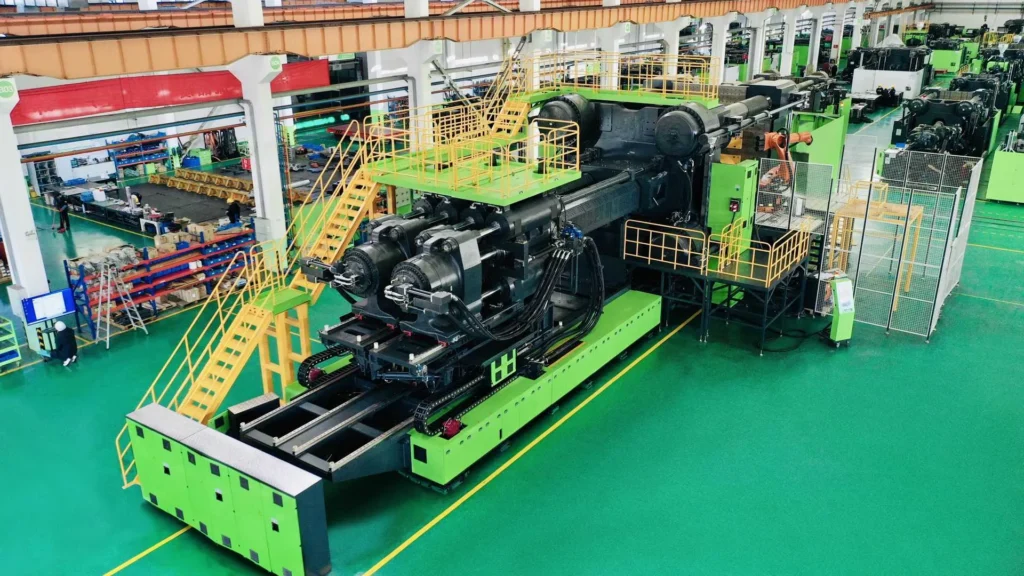
- Waste Plastic Handling (Phased Implementation): 1. Initial stage (1-3 months): Equip a small crusher (such as Ruilang RL-300, $2,250 per unit) to crush sprue materials and defective products into particles, which are mixed with new materials at a ratio of 1:4 (small-batch trial production is required first to ensure product strength meets standards); 2. Mid-stage (3-6 months): Add a simple granulator (such as Lianxin LX-160, $9,000 per unit) to process crushed particles into recycled materials, increasing the mixing ratio to 1:3; 3. Management details: Establish a waste plastic ledger to record crushing volume, mixing ratio, and product qualification rate, avoiding quality issues caused by improper use of recycled materials. The total investment is controlled within $11,250. For an output of 50 tons/month, 12.5 tons of recycled materials are used monthly, reducing raw material costs by 18%, saving approximately $2,160 per month, and the investment can be recovered in 6 months.
- Energy-Saving Transformation (Quick Results): 1. Frequency conversion transformation: Install frequency conversion energy savers (such as Delta VFD-B series, $600 per unit) for injection molding machines (below 100 tons), setting parameters of “frequency reduction during no-load and frequency increase during load.” Power consumption per unit decreases from 200 kWh/day to 180 kWh/day, saving 600 kWh/month and approximately $648 in annual electricity costs; 2. Thermal insulation optimization: Install nano-insulation sleeves (such as Ketai KT-800, $75 per set) on the barrel to reduce heat loss, shortening heating time from 40 minutes to 28 minutes and increasing production efficiency by 30%; 3. Waste heat utilization: Guide the barrel heat dissipation duct to workshop heating equipment (for winter use) to reduce heating energy consumption.
- Environmentally Friendly Materials (Gradual Replacement): 1. Entry-level: Adopt the “recycled material + new material” mixing scheme (e.g., 30% PC recycled material), suitable for non-appearance parts (such as electrical brackets); 2. Advanced level: Gradually replace 20%-30% of traditional plastics with biodegradable materials (PLA costs approximately $2,700/ton, $450/ton higher than ABS), suitable for appearance parts; 3. Market connection: Obtain international certifications such as Global Organic Textile Standard (GOTS) and Global Recycled Standard (GRS) (costing approximately $3,000, with subsidies available), and cooperate with foreign trade companies or international high-end brands. The profit margin of such products is over 25% higher than that of ordinary products.
2.3 Silicone Process: From “Excessive Solvent Emissions” to “Clean Production”
The main pollution source of the silicone process is volatile organic compounds (VOCs) in release agents and cross-linking agents. In 2024, global environmental supervision has listed it as a “key inspection item.” Most countries clearly stipulate that VOCs emission concentrations must be below 60mg/m³, and enterprises exceeding the standard will face “production suspension for rectification + daily fines,” so priority must be given to transformation.
Key Transformation Measures:
III. Three Guarantee Measures for Green Transformation: Reducing Trial-and-Error Risks
SMEs’ green transformation should be carried out “step by step and steadily” to avoid blind investment. A guarantee system can be established from the following three aspects:
- Material Replacement (Core Measure): 1. Release agent: Choose water-based environmentally friendly type (such as Dow Corning DC-111, $2.25/liter, equivalent to the price of traditional solvent-based products), and dilute it with water at a ratio of 1:5 before use to avoid direct use of undiluted solution; 2. Cross-linking agent: Replace with low-VOCs type (such as Wacker C-80, $4.2/kg, $0.45/kg higher than ordinary types, but VOCs emissions reduced by 95%); 3. Purchasing skills: Sign an “environmental compliance commitment letter” with suppliers and require them to provide reports from international testing institutions such as SGS and Pony to avoid purchasing “fake environmentally friendly” materials. With monthly consumption of 500 liters of release agent and 100 kg of cross-linking agent, the monthly cost increases by approximately $120, but the risk of $30,000 fines can be avoided.
- Waste Gas Collection (Compliance Guarantee): 1. Workstation-level collection: Install small air-collecting hoods (such as Baitwei BT-100, $120 each) above each silicone molding machine, with the hood opening 15-20 cm away from the equipment to ensure collection efficiency; 2. Centralized treatment: Guide waste gas to activated carbon adsorption devices (such as Lvshen LD-5000, $3,750 per set, capable of handling 5-8 workstations) through pipelines, and replace activated carbon once a month (costing approximately $75); 3. Testing and verification: Entrust third-party testing institutions such as SGS and Pony to conduct emission testing quarterly, costing approximately $225 per test, to ensure data compliance and retain reports.
- Process Optimization (Cost Reduction and Efficiency Improvement): 1. Mold upgrading: Adopt “one-time molding” mold design to reduce the number of parting surfaces, lowering silicone consumption by 15%; 2. Parameter adjustment: Reduce the curing temperature from 180℃ to 160℃ and extend the curing time by 5 minutes, reducing energy consumption by 11% while decreasing VOCs volatilization; 3. Employee training: Develop an “Environmental Protection Operation Manual” to standardize the spray volume of release agent (2-3 sprays per mold is sufficient to avoid excess) and reduce material waste. After transformation, waste generation is reduced by 40% and production efficiency is increased by 20%.
- Policy Preference Utilization (Reducing Initial Investment): 1. Subsidy application: Query local policies on the International SME Alliance Platform (www.smealliance.org). For example, the EU’s “Green Transformation Special Subsidy” covers up to 30% of the cost, and some Southeast Asian countries’ “Environmental Protection Equipment Purchase Subsidy” can reimburse 20% of the equipment cost. A “transformation plan + budget statement + EIA report” is required for application; 2. Financial support: Cooperate with local commercial banks or policy-based financial institutions to apply for “green credit” (with an annual interest rate 1-2 percentage points lower than ordinary loans), and some regions provide “financial interest subsidies”; 3. Resource sharing: Join the “SME Environmental Protection Mutual Assistance Alliance” (contactable through local chambers of commerce) to share testing equipment (such as VOCs detectors, with shared costs), and environmental protection technical consultants (unified hired by the alliance) to reduce individual operation and maintenance costs.
- Small-Scale Pilot Verification (Controlling Trial-and-Error Risks): 1. Pilot selection: Prioritize links with “severe pollution, easy transformation, and quick results,” such as transforming 1 cutting machine and 1 leftover material collection workstation in the sewing workshop, and transforming the frequency conversion system of 1 equipment in the injection molding workshop; 2. Cycle setting: Run the pilot for 1 month, focusing on tracking three indicators: “investment cost, energy consumption change, and product qualification rate.” For example, after the silicone process pilot, if VOCs emissions meet standards and material cost increase is ≤5%, full-scale promotion can be carried out; 3. Problem adjustment: If problems such as “recycled materials affecting product strength” and “poor curing effect of environmentally friendly materials” occur, communicate and optimize with equipment suppliers and material manufacturers in a timely manner to avoid expanding losses.
- Market Value Conversion (Enhancing Profit Margins): 1. Certification support: Prioritize obtaining internationally recognized environmental certifications such as Global Organic Textile Standard (GOTS) and Global Recycled Standard (GRS), costing approximately $3,000-$4,500, with 50% of the cost covered by government subsidies; 2. Brand promotion: Print “environmentally friendly materials” and “recycled” logos on product packaging, and highlight the selling point of “green processes” on e-commerce detail pages. For example, Amazon’s “Sustainable Packaging Program” can provide traffic support, increasing unit price by 10%-15% with higher repurchase rates; 3. Customer development: Target customers who value environmental protection, such as international foreign trade companies, maternal and infant brands, and high-end home furnishing enterprises. These customers have low price sensitivity, value compliance more, and provide more stable orders.